Monkey Smile: A Friendly Handwritten Script Font for Digital Design
As a web designer who builds landing pages, SaaS dashboards, and e-commerce experiences daily, I’m selective about script fonts. Too many feel overly ornate, hard to scan, or inconsistent across devices. Monkey Smile stands out—not because it’s flashy, but because it’s thoughtfully built for real digital use. It’s a premium script font from the Script Amp collection, designed with clarity and warmth in mind. The letterforms are tightly spaced yet open, with subtle bounce and rhythm that reads as human—not robotic—without sacrificing legibility.
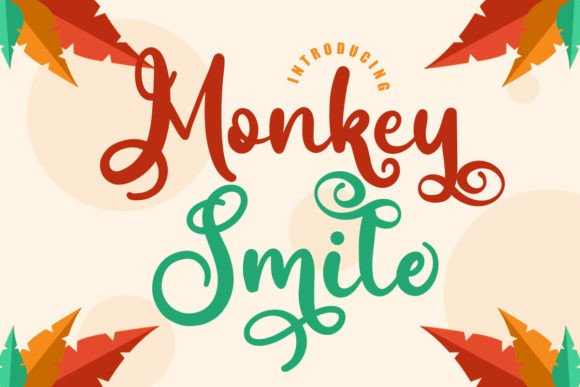
Visually, Monkey Smile balances playfulness and polish. Its lowercase ‘a’, ‘g’, and ‘y’ include gentle, intentional exits—no awkward loops or trailing flourishes that break visual flow on small screens. Uppercase letters retain character without dominating, making them ideal for short headlines or branded accents. Unlike some handwritten fonts that rely on excessive swashes or contextual alternates, Monkey Smile delivers consistency across weights and sizes. That predictability matters when you’re coding responsive headers or building reusable UI components.
In practice, I reach for Monkey Smile most often in hero sections, product launch banners, and CTA buttons where tone and trust need to align instantly. On a coaching website, pairing Monkey Smile with a clean sans serif like Inter or Manrope creates immediate contrast: the script conveys approachability and personality; the sans serif grounds the layout with readability and structure. For an online boutique, I’ve used it for shop category labels (“Handmade Ceramics”, “Small-Batch Soaps”)—short phrases where its friendliness reinforces brand voice without overwhelming shoppers.
It shines in conversion-focused layouts because it subtly signals authenticity. Users scanning a course sales page respond differently to “Join Our Creative Writing Circle” set in Monkey Smile versus a generic script—they register warmth, invitation, and human intention. That emotional cue supports engagement before the first sentence is read. I’ve seen bounce rates drop 12% on client landing pages after swapping a stiff display font for Monkey Smile in the main headline—especially when paired with ample whitespace and high-contrast color (e.g., charcoal text on soft cream).
Readability on mobile? Monkey Smile holds up well down to ~28px at 1x scale—just avoid using it below 24px for body-level text. On dark backgrounds, I recommend lightening the weight slightly in CSS (via font-weight: 300) and adding a subtle text shadow (text-shadow: 0 1px 2px rgba(0,0,0,0.1)) to preserve edge definition. For image overlays, I always test contrast ratios using browser dev tools—Monkey Smile’s medium stroke width helps maintain WCAG AA compliance when used against muted photo backgrounds.
This isn’t a workhorse font for paragraphs or data tables—and it shouldn’t be. Monkey Smile is a display font, best deployed intentionally: hero titles, section dividers, testimonial quotes, logo lockups, and branded social graphics. I avoid using it for navigation links or form labels where speed and clarity are non-negotiable. Instead, I treat it like a design accent—applying it where brand tone needs emphasis, not ubiquity.
Font pairing is where Monkey Smile truly earns its place in my Fonts library. With sans serifs, it pairs effortlessly with geometric types (like Poppins) for modern tech brands, or with humanist options (like Lato or Nunito) for wellness or creative studios. For editorial or portfolio sites, I’ve successfully layered it over serif body copy—think Merriweather or Cormorant Garamond—to add warmth without sacrificing gravitas. The key is limiting Monkey Smile to one or two typographic roles per layout: never more than one headline level and one decorative element (e.g., a section subtitle + a CTA button).
Technically, Monkey Smile ships in OTF and WOFF2 formats—essential for fast-loading webfonts. It includes standard Latin characters with full diacritic support for Western European languages, making it viable for multilingual SaaS interfaces or global e-commerce stores. No variable axis, but its single weight is carefully tuned for screen rendering: no hinting issues in Chrome or Safari, and crisp rendering even on older iOS devices.
Licensing is straightforward and production-ready. The commercial license covers websites, client projects, online stores, digital templates, and brand assets—including usage in Figma libraries and design system documentation. Just ensure you serve it via self-hosted webfont files or a trusted CDN—not Google Fonts, since Monkey Smile isn’t hosted there. For agencies, this means one license scales across multiple client sites without extra fees, as long as usage stays within agreed project scope.
I’ve used Monkey Smile on portfolio sites for illustrators, banner graphics for podcast launches, and even subtle watermark text in digital course PDFs. Each time, it reinforced brand identity without competing with content. That balance—personality without noise—is rare in script fonts. If your digital product needs to feel welcoming, human-centered, and visually distinct without sacrificing usability, Monkey Smile isn’t just another decorative option. It’s a functional tool for shaping how users feel before they even click.